
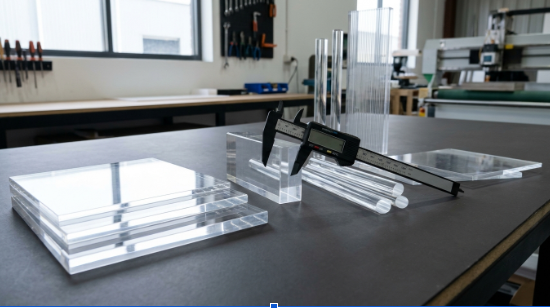
Industries often require Perspex cut to size to create precise, durable and professional-looking components for machine guards, protective screens, retail displays, signage and custom fabrication projects.
However, ordering Perspex cut to size sounds straightforward until you reach the thickness field. You might know the exact width and height of a display panel, protective screen, or replacement insert, yet still wonder whether a thinner sheet will flex or a thicker one will be unnecessarily heavy.
The important questions are how far the sheet spans between supports, what will press against it, where it will be installed, and how its edges will be secured. This guide helps you specify a panel before ordering.
What Thickness Perspex Do I Need?
Choose acrylic thickness from the panel’s unsupported dimensions, support arrangement, expected loading, and acceptable flex. Small decorative inserts can often be thinner than large freestanding panels, but no single thickness is appropriate for every sign, screen, shelf or glazing opening. So, it is always better to review the full installation before deciding, and for safety-critical glazing or guarding, a qualified designer must assess the complete assembly.
What Does Perspex Sheet Thickness Mean?
Perspex is a trade name commonly associated with acrylic, technically known as polymethyl methacrylate (PMMA). In everyday purchasing, people often use Perspex to describe clear acrylic Plastic Sheets generally; confirm the actual material and grade when ordering rather than assuming every acrylic panel is identical.
Thickness is the distance between the two broad faces of the sheet, measured in millimetres. Increasing thickness generally improves bending stiffness, but it also changes weight, price, edge appearance, and fabrication requirements. Actual sheet thickness may vary within manufacturing tolerances, which matters when panels fit into narrow channels or interlocking slots.
Common acrylic sheet thicknesses
Buyers frequently encounter 2, 3, 4, 5, 6, 8, 10, and 12 mm sheet, with heavier options available from some suppliers. These ranges do not guarantee stock; colour, finish, and grade affect availability. Start with the requirements of the finished panel, then confirm the suitable thickness can be sourced.
Cast acrylic or extruded acrylic?
Both are PMMA, but their manufacturing processes and tolerance behaviour differ. Cast acrylic is often selected for machining, polished edges and specialist fabrication; extruded acrylic may suit repeatable profiles and selected formed products. Ask about the grade when tight slot fits, intricate cutting, or a particular visual finish are important. Neither manufacturing process removes the need to check the finished panel’s loading.
Why Panel Dimensions and Support Spacing Matter
Measure the unsupported span, not just the overall size
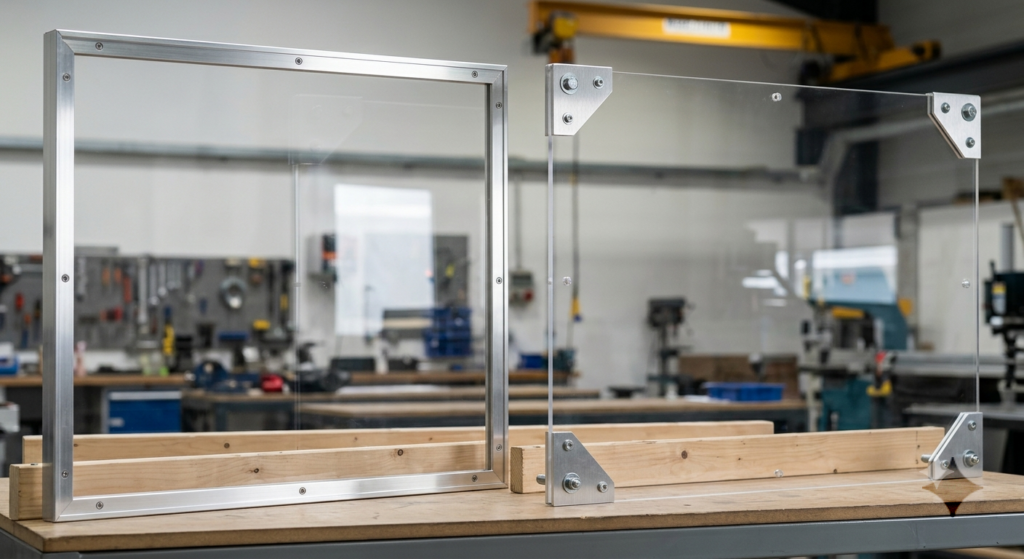
A 900 mm wide acrylic panel captured continuously in a rigid frame behaves differently from a 900 mm panel attached only at its corners. The second arrangement leaves more freedom for movement and can place greater stress around the fixings. So, measure the clear opening between supports and describe whether the panel is supported on two, three, or four sides. Intermediate rails or better edge support may improve stiffness, provided the frame is rigid.
Think about the type and duration of load
A vertical sign carrying only its own weight faces different demands from a horizontal shelf holding products. Wind, cleaning pressure, accidental knocks, and vibration can introduce loads that are easy to overlook. Long-term loading can cause gradual movement in plastics, while short impacts raise different concerns. So, check whether the design needs minimal visible bowing, occasional flexibility, or a formally verified safety performance.
Application Guide: What Should You Check?
Use this table to narrow the design questions before ordering.
| Project | Questions that affect thickness | Practical direction |
| Small signs and picture inserts | Panel size, edge frame, handling, visible flex | Review thinner formats where the panel is closely supported. |
| Retail displays and risers | Product weight, shelf span, bonded joints, repeated use | Check bending and joint strength before choosing a gauge. |
| Countertop protective screens | Height, base stability, fixing points, foreseeable contact | Assess the whole mounting system, not just sheet thickness. |
| Replacement glazing inserts | Opening size, frame retention, wind, human impact, compliance | Confirm the use is permitted and have safety requirements assessed. |
| Equipment covers | Impact risk, access, heat, maintenance, enclosure geometry | Review whether impact-resistant polycarbonate is preferable. |
| Outdoor signs and panels | Wind exposure, thermal movement, UV grade, frame spacing | Allow movement and validate the panel and fixing design. |
Choosing Thickness for Protective Screens
For reception counters, desk partitions and display dividers, the main issues are panel height, resistance to wobble and how the sheet connects to its supports. A tall screen held by two small feet may move more than a similar panel secured along its lower edge. Drilled holes and cut-outs can concentrate stress.
If the screen is only a low-risk visual divider, the specification may focus on stability and appearance. If it is expected to contain flying objects, resist significant impact, or protect machinery operators, it becomes a different engineering problem.
So, review the relevant machine guarding requirements and assess impact-resistant alternatives rather than treating ordinary acrylic as a certified barrier.
Choosing Thickness for Retail Displays and Signage

Signage often depends on visual proportion as much as strength. A small supported nameplate may use relatively thin sheet, whereas a freestanding menu board needs enough rigidity to remain upright during handling. Suspended signs also need carefully designed hangers and fixing holes; a beautiful polished edge does not compensate for a weak mounting arrangement.
For shelves and product risers, tell the fabricator the maximum product weight and the distance between the supporting brackets. Consider whether the load sits near the centre or spreads across the surface. If you need curved shapes, engraved details or repeated identical parts, laser cutting and CNC routing options should be discussed before dimensions are finalised.
Choosing Thickness for Replacement Glazing Panels
Replacement glazing requires particular care. A damaged cabinet insert is not equivalent to a window beside a doorway or an overhead panel exposed to weather. Frame depth, panel retention, wind pressure, access and the likelihood of human impact all influence material suitability.
For context, the Australian Government’s Your Home guidance on glazing describes secondary glazing systems that may use an acrylic inner panel, but that does not establish approval for substituting acrylic into every existing window. For regulated building glazing or safety-sensitive locations, confirm applicable National Construction Code provisions and obtain qualified advice before ordering.
You may also provide a sketch or photograph of the existing frame, the clear opening size, and the proposed retention method. Cutting accuracy cannot replace appropriate installation.
How Outdoor Conditions Change the Decision
Clear acrylic can be useful for outdoor signage, but thickness alone cannot overcome an unsuitable fixing design. Sunshine and temperature changes cause sheets to expand and contract, and a panel clamped tightly in every direction can develop unwanted stress. However, allowances for thermal movement depend on the sheet dimensions, temperature range, and mounting design.
For exposed signs, establish whether wind loading is relevant and whether the selected grade has appropriate outdoor performance. Keep drilling and fitting details consistent with the supplier’s fabrication guidance. Avoid over-tightening fasteners, placing holes too close to edges or using incompatible cleaners that may encourage surface crazing.
Perspex Versus Polycarbonate: Which Is Better?

Acrylic is usually favoured where clarity, appearance and a polished finish dominate the brief. Polycarbonate, sometimes sold under the Lexan trade name, is generally considered when much greater impact toughness is important. Neither choice should be made solely from a thickness number; their stiffness, scratch behaviour, weathering grades and fixing details differ.
If impact is central to the application, consider polycarbonate before simply making acrylic thicker. For any protective screen or guard, have the complete assembly evaluated against its actual hazard. A panel may resist a knock but still fail at an unsuitable hinge, mounting hole, or bracket.
When Another Plastic Sheet Makes More Sense
Cut to size acrylic is not the answer to every industrial job. If a panel does not need to be transparent, other polymers may offer a better combination of wear resistance, chemical performance, weight, or cost.
- HDPE, a type of Polythene, is often considered for wet environments, liners, and general-purpose components where optical clarity is irrelevant.
- Polypropylene can suit selected chemical-processing applications, subject to compatibility checks.
- PVC may suit rigid enclosures or certain chemical-service requirements.
- ABS Sheets can be useful for impact-tolerant housings and formed parts.
Remember, each material has limitations. So, compare the intended service conditions against grade-specific information instead of treating these names as interchangeable substitutes for Perspex.
Perspex Thickness Selection Checklist
Before requesting a cut-to-size quote, work through these eight checks. A clear answer to each one makes material and fabrication advice more useful.
- What are the finished dimensions? Specify width, height, shape, and units, including any cut-outs.
- What is the unsupported span? Measure the clear distance between rails, brackets, or frame edges.
- How is the panel supported? Describe two-sided, three-sided, four-sided, or point fixing.
- What loads will it face? Include product weight, wind, knocks, vibration, and routine contact.
- How much movement is acceptable? State whether visible bowing would affect fit, appearance, or operation.
- Is the environment demanding? Identify outdoor exposure, heat, chemicals, and frequent cleaning.
- Are there safety or compliance duties? Flag glazing, guarding, overhead use, and human-impact risks for assessment.
- What finish and processing are required? Confirm colour, cast/extruded preference, edges, holes, and tolerances.
What to Include in a Cut to Size Acrylic Quote
Give the supplier the number of pieces, final dimensions, preferred finish, purpose, and approximate operating conditions. Add a drawing or annotated photograph for unusual shapes. Mark which dimensions are critical, especially slots for brackets or parts that must align with existing fittings. Also, ask whether nominal thickness or an actual measured tolerance is more relevant to the assembly.
Further, make sure you state whether edges need polishing, whether holes must be drilled or countersunk, and whether components require fabrication and assembly. This prevents a quote for basic rectangular cutting from being mistaken for the price of a finished component.
Frequently Asked Questions
It can be appropriate for some small, closely supported decorative pieces, but may not be automatically suitable for a large freestanding screen, shelf or glazing panel. It is always better to check span, support, loading and service conditions.
Neither is universally better. The choice depends on display dimensions, expected handling, edge support, and product load. If stiffness is critical, assess the assembled design rather than comparing thicknesses alone.
Often, because a larger unsupported span generally increases visible bending. However, intermediate supports or a more effective frame can change the requirement. Overall panel size is only part of the calculation.
Sometimes, depending on the location, installation, and applicable requirements. Do not assume acrylic can replace specified safety glazing, structural glazing, or overhead glass without a qualified compliance review.
They have different performance strengths. Acrylic offers excellent clarity and finish; polycarbonate products, including Lexan grades, generally provide substantially higher impact toughness. Compare the exact grades and loading before deciding.
Not necessarily. Many designs require suitable clearance for thermal movement and reduced local stress. Hole size, edge distance, washers, and tightening procedure should follow the material and fixing specification.
Accurate enough for the intended fit, while allowing for manufacturing tolerances and installation clearance. Provide finished dimensions and nominate any critical holes, channels, or slots rather than assuming a perfect zero-clearance fit.
Choose the Panel That Suits the Whole Project
The right acrylic thickness is the result of the design, not a shortcut based on one popular sheet size. Once you know the span, supports, loading, and installation conditions, it becomes easier to weigh thickness against material type, finish, and fabrication cost.
If your measurements are ready but the material specification is not, you may share your dimensions, sketch, and intended application through an enquiry form. A useful discussion can clarify what needs verifying before the sheet is cut.